FortunePlay Payments in Australia: AUD Deposits, Cards, Wallets and Crypto
 Available in AU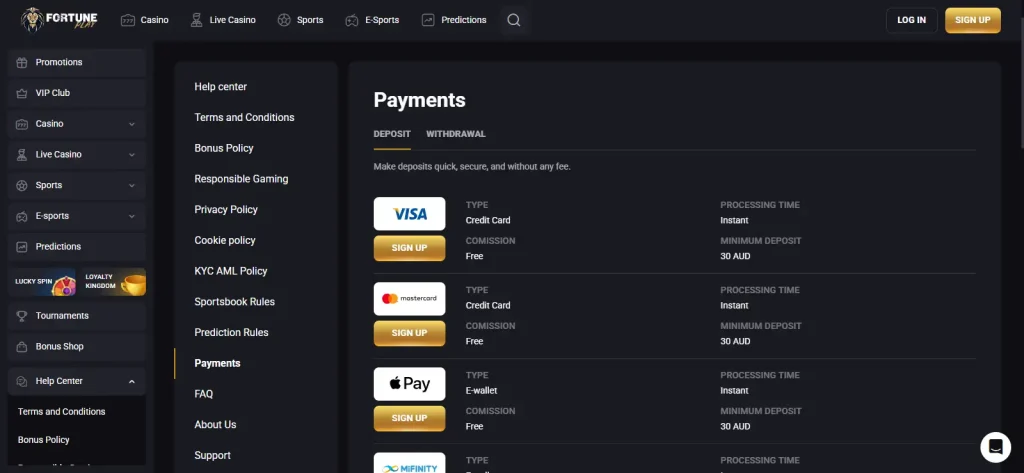
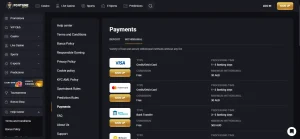
FortunePlay’s current AU payments page lists Visa, Mastercard, Apple Pay Mastercard and MiFinity as fiat deposit methods, each with a A$30 minimum, a “Free” commission label and “Instant” processing. The same cashier also lists several cryptocurrencies, including Bitcoin, Ethereum, Litecoin, Bitcoin Cash, Dogecoin and USDT, with minimums shown as crypto amounts equivalent to EUR 20. AUD is supported, so Australian users can view the main card and wallet thresholds directly in Australian dollars.
A useful local comparison is PayID. It is widely used in Australia, while FortunePlay’s current AU deposit table lists other methods instead. The Reserve Bank of Australia’s 2025 Consumer Payments Survey also shows why the listed card and mobile-wallet options are locally familiar: cards accounted for about 73% of consumer payments, and 43% of consumers used a mobile device for a contactless payment during the survey diary week.
Table of Contents
- Current AU fiat deposit methods
- How the cashier fits Australian payment habits
- PayID is popular in Australia; FortunePlay lists other methods
- Crypto deposits and the EUR-equivalent minimum
- Deposits and withdrawals can use different methods
- How to interpret the A minimum
- Cards, Apple Pay Mastercard or MiFinity: how to compare them
- Account setup can affect payment success
- AUD cashier checklist
- Payment details can change
Current AU fiat deposit methods
The live FortunePlay AU payments table is concise. For fiat deposits it currently lists two card entries and two wallet-style entries. All four show the same A$30 minimum and the same site-side labels for commission and processing speed.
| Method | Type shown by FortunePlay | Minimum deposit | Commission label | Processing label |
|---|---|---|---|---|
| Visa | Credit Card | A$30 | Free | Instant |
| Mastercard | Credit Card | A$30 | Free | Instant |
| Apple Pay Mastercard | E-wallet | A$30 | Free | Instant |
| MiFinity | E-wallet | A$30 | Free | Instant |
“Free” is FortunePlay’s commission label for the method; banks, card issuers, wallet providers or currency-conversion services can still apply their own charges. Likewise, “Instant” describes the cashier’s processing label, while security checks, issuer decisions and payment-provider availability can affect end-to-end timing.
A useful Australian convenience is that the fiat minimum is displayed in AUD, avoiding mental conversion from EUR or USD. That makes the card and wallet thresholds straightforward to compare with your intended deposit size.
How the cashier fits Australian payment habits
The RBA’s 2025 Consumer Payments Survey found that cards remained Australia’s dominant consumer payment method, accounting for around 73% of payments. Debit cards alone accounted for roughly half of consumer payments. FortunePlay’s AU cashier therefore leads with methods that are already familiar in the broader Australian payment environment: Visa and Mastercard.
Mobile-wallet use is also mainstream. The RBA reports that 43% of consumers used a mobile device to make a contactless payment during the survey diary week in 2025, up from 35% in 2022. FortunePlay’s listing of Apple Pay Mastercard fits that trend, although the exact entry matters: the cashier specifically lists Apple Pay Mastercard, so support depends on that named method.
This local context is useful because a payment page can look broad simply by displaying many logos. A better question is whether the methods match how people actually pay. Cards and mobile wallets clearly do in Australia. Their familiarity in Australia makes them natural methods to evaluate first, while actual transaction success still depends on issuer and payment-provider conditions.
PayID is popular in Australia; FortunePlay lists other methods
PayID deserves explicit treatment because it is a common Australian account-to-account service. The RBA says around 50% of respondents in its 2025 survey reported using PayID in the prior year, up from 32% in 2022. Awareness reached around 80%.
Despite that broader popularity, the current FortunePlay AU deposit table lists other methods. Keeping PayID outside the FortunePlay method list is more accurate than importing a generic list of popular Australian payment options. A local method can be popular nationally yet remain absent from a particular cashier.
If PayID is your preferred way to fund online services, check the live cashier rather than assuming support from Australian localisation alone. Payment menus can change over time, so any future addition should be confirmed in the current FortunePlay AU cashier.
Crypto deposits and the EUR-equivalent minimum
FortunePlay also lists cryptocurrency deposits. The current AU table includes Bitcoin, Ethereum, Litecoin, Bitcoin Cash, Dogecoin and USDT, with other crypto entries potentially visible as the payment menu evolves. The key presentation detail is an EUR-equivalent threshold: each crypto minimum is displayed as an amount equivalent to EUR 20 rather than as a fixed AUD value.
Crypto adds another complication because asset values move. The cashier can express a threshold by reference to EUR while the amount of BTC, ETH or another asset required to meet that value changes. A fixed cryptocurrency quantity would age quickly, so the live cashier amount is the useful reference.
For someone already holding cryptocurrency, the comparison extends beyond deposit speed: network fees, asset volatility, exchange spreads, wallet accuracy and whether withdrawals can be returned through the same rail. Deposit listing and withdrawal availability can differ.
Deposits and withdrawals can use different methods
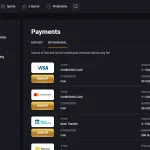
The FortunePlay payments page has distinct Deposit and Withdrawal views. The withdrawal table currently includes Visa and Mastercard with 1-3 banking day labels, Bank Transfer with a 3-5 banking day label and a A$500 minimum, plus several crypto methods shown as instant. Those payout details depend on processing rules, verification and method-specific limits; withdrawal times and limits sets them out separately.
A convenient deposit route can still lead to a different payout path. Apple Pay Mastercard and MiFinity, for example, appear in the deposit table, while the withdrawal table can show a different set of methods. Check the withdrawal view before choosing a deposit method when using the same route for payouts matters.
Identity verification can also affect withdrawals even when deposits are marked instant. Deposit speed therefore tells little about the eventual payout timeline.
How to interpret the A$30 minimum
The A$30 figure is useful because it is consistent across the four fiat deposit entries currently displayed on the AU page. It identifies the smallest amount FortunePlay shows for those methods. Budget suitability, promotion eligibility and card authorisation remain independent considerations.
If you are considering a promotion, check the bonus deposit rules separately. The current general bonus policy also uses A$30 as the AUD equivalent minimum for receiving a bonus, but promotions can have their own conditions. A cashier minimum and a promotion minimum can share the same threshold while remaining separate rules.
For budgeting, the better approach is to decide your maximum affordable spend first and then see whether the cashier minimum fits within it. Raising a planned deposit solely to unlock a payment method or bonus can undermine the purpose of a personal spending limit.
Cards, Apple Pay Mastercard or MiFinity: how to compare them
- Visa and Mastercard
- These are the most conventional options in the current AU cashier. They are familiar in Australia and displayed with a A$30 minimum. Card issuer acceptance still matters.
- Apple Pay Mastercard
- This can suit users who already prefer device-based payments, but the listing is specifically Apple Pay Mastercard. Treat the listing as specific to Apple Pay Mastercard and confirm the funding card in the live cashier.
- MiFinity
- This is listed as an e-wallet with the same A$30 minimum and site-side “Free” and “Instant” labels. It may appeal to users who prefer separating gambling payments from their primary bank card, provided they already use or are comfortable with the wallet.
- Crypto
- This can suit users who already hold supported assets, while network and price considerations affect crypto more directly than AUD card deposits.
Method choice depends on which supported rail you already understand, what fees your own provider may charge, how you intend to withdraw and whether the method fits your budget.
Account setup can affect payment success
FortunePlay’s general terms state that deposits must come from a payment account registered in the player’s own name. That rule is more important than the logo chosen at checkout. Using another person’s bank account, card or wallet can trigger security issues and make later verification more difficult.
Before funding an account, make sure the registration details and payment ownership are consistent. account setup sets out the registration requirements that can affect later checks. Accurate personal information from the start can reduce avoidable friction.
Payment localisation and AUD support describe the product. Australian regulatory treatment follows the separate regulator record.
AUD cashier checklist
- Confirm the method is still visible on the live AU payments page.
- Check the displayed minimum in AUD for fiat deposits.
- Treat “Free” as the site’s own commission label and check third-party charges as well.
- Treat “Instant” as the displayed processing label and allow for issuer, security or provider handling.
- If using crypto, check the live asset amount because the minimum is expressed as an EUR-equivalent threshold.
- Open the withdrawal tab before depositing if you want the payout route to match your preferred funding method.
- Treat PayID as unsupported until it appears in the live FortunePlay cashier.
- Use a payment method in your own name and keep deposit size inside a pre-set budget.
Payment details can change
On 17 September 2026, FortunePlay’s AU cashier listed the methods and thresholds described above. The Reserve Bank of Australia’s May 2026 bulletin, based on the 2025 Consumer Payments Survey, provides the Australian payment-market context. FortunePlay can change its cashier menu, so live availability remains the decisive method check.
Games, bonuses, mobile access and regulatory context sit alongside cashier details in the FortunePlay Australia review.